
Dermamelan
Medical-grade treatment designed to address persistent pigmentation concerns.
Dermamelan Treatment at a Glance
Benefits of Dermamelan
It minimises stubborn dark spots and melasma and prevents recurrence by regulating melanin production.
Treatment Time
Typically two short appointments for the skin preparation and the in-clinic application, followed by a structured at-home phase.
Downtime
A temporary tight or warm sensation, with mild swelling and visible peeling typically lasting 5–7 days.
Areas of Concern
Uneven skin tone, melasma and age-related pigmentation affecting the face.
Results Timeline
An initial depigmenting effect may be observed from 4–6 weeks, with more noticeable improvement developing over 6–8 weeks.
What Is Dermamelan?
Dermamelan peel is formulated to target pigmentation issues across all skin types and tones. Made with a combination of ingredients such as azelaic acid, kojic acid, phytic acid, ascorbic acid, arbutin and titanium dioxide, it is commonly prescribed for concerns such as melasma, sun-related pigmentation and discolouration associated with hormonal changes or ageing.
The treatment combines an in-clinic application with a structured home care phase, helping to maintain a clearer, more even-looking complexion. Over time, the skin may appear brighter, with dark spots becoming less noticeable over time.
How Dermamelan Treatment Works
Dermamelan is delivered through a structured, two-stage protocol:
Stage 1: In-Clinic Phase
Following a comprehensive assessment of your pigmentation, treatment begins with skin preparation and a professional chemical peel.
At your subsequent appointment, a depigmenting mask is applied in the clinic to initiate intensive pigment regulation. The application typically takes around 20 minutes. The mask remains on the skin for a prescribed period (usually 4 hours) before being removed at home as directed by your clinician.
Stage 2: At-Home Management Phase
The second phase involves an at-home regimen, typically followed over several months. Consistent use of Dermamelan home care products is required to reinforce the in-clinic treatment and achieve more targeted and sustained outcomes. During this phase, you will attend regular appointments with your dermal clinician to monitor your skin’s progress and adjust your skincare routine as needed.
Begin with a consultation at the Muse Institute of Aesthetic Medicine to assess whether Dermamelan is appropriate for your skin. Your treatment plan will be guided by clinical insight and personalised to support long-term skin clarity.
What Skin Concerns Can Dermamelan Help to Address?
Dermamelan peel may be recommended for a range of pigmentation concerns:
- Melasma — A form of pigmentation that can develop during pregnancy or with hormonal changes.
- Sun-induced pigmentation — Areas of darkening caused by cumulative UV exposure, commonly appearing as uneven tone or isolated spots.
- Post-inflammatory hyperpigmentation — Residual discolouration that can occur following breakouts, irritation or skin injury.
- Freckles and age spots — Small or diffuse areas of pigment influenced by genetics or the natural ageing process.
Is Dermamelan Right for You?
You may be an appropriate candidate for a Dermamelan peel if:
- You are experiencing persistent pigmentation — Suitable for individuals with hyperpigmentation that has not responded to standard treatments.
- You are seeking a long-term approach — Dermamelan is designed to regulate pigment production at its source rather than relying on surface-level exfoliation alone.
- You are able to commit to Dermamelan before and aftercare — The treatment involves pre- and post-treatment protocols to ensure a safe and smooth experience.
Dermamelan may not be suitable in certain circumstances, including:
- Pregnancy or breastfeeding
- Active herpes simplex infection
- Ongoing skin inflammation or irritation
An in-depth assessment is required to determine suitability based on your skin condition, medical history and treatment goals.
Dermamelan Treatment Results
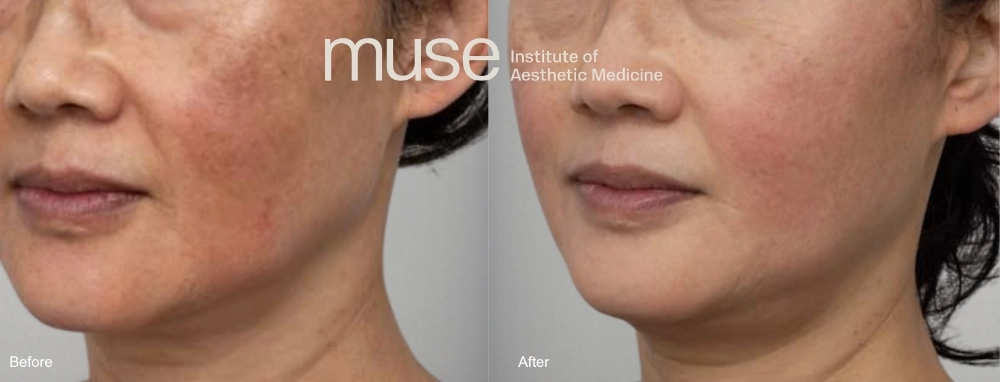
Dermamelan Treatment Cost in Sydney
The cost of Dermamelan treatment in Sydney varies depending on your individual skin concerns and the level of care required. A personalised treatment plan, including pricing, will be provided following your initial consultation.
Results & Recovery
Most individuals are able to resume their daily activities following the appointment. Follow these tips to keep your skin looking healthy throughout the recovery period:
- Apply broad-spectrum sun protection daily to minimise UV-related pigment recurrence.
- Adhere closely to your prescribed home care regimen.
- Avoid active or potentially irritating products unless advised by your clinician.
- Maintain hydration with gentle, barrier-supporting skincare.
Potential Risks & Side Effects
Redness, peeling and increased sensitivity may occur, especially in the first few days after mask application. These effects are typically temporary and will be explained in detail during your consultation. Following your post-treatment care plan can help manage discomfort.
Book a Consultation
Minimise pigmentation through bespoke clinical care. Schedule a consultation at the Muse Institute of Aesthetic Medicine to assess whether a Dermamelan peel is appropriate for your skin.
Why Choose Muse Institute of Aesthetic Medicine
The Muse Institute of Aesthetic Medicine operates under the clinical leadership of Dr Stephen Lowe, whose work in education and research informs the standard of care across the clinic. Our team of university-qualified dermal clinicians brings a depth of knowledge that supports the management of complex pigmentation issues, rosacea, fine lines and other common skin concerns.
Book an appointment today and let us take care of your skin’s long-term health.
Frequently Asked Questions
The most significant change occurs within a few weeks from applying the mask. You’ll notice an improvement in skin texture and a reduction of hyperpigmentation due to melanin (pigmentation) being removed from the outer layers of the skin. However, you must continue the treatment for the entire six months, as removing the accumulated melanin is not enough. We need to also regulate its overproduction and minimise its reappearance.
Dermamelan is a non-invasive topical treatment and does not prevent you from continuing your usual activities. However, it is vitally important that the daily homecare regime is maintained and sun exposure avoided as much as possible to maximise results.
For most people, one initial Dermamelan mask followed by the six-month home skincare program will be sufficient. You may need a top up treatment after a month or so if you have very stubborn pigmentation. Depending on the response to the treatment and desired outcome, some patients will opt to have maintenance Dermamelan treatment annually to keep their pigmentation at bay.
Pigmentation spots will be significantly reduced following the treatment, but not every spot may disappear altogether. Occasionally, patients may need a repeat treatment with Dermamelan or a combination with another treatment modality such as laser for improved results. It is essential to follow your prescribed home care routine and to consistently use specific SPF protection to minimise repigmentation.
Dermamelan can be performed anytime if patients practice adequate sun avoidance and use a high SPF sunscreen.
Other treatments such as laser or peel have a corrective action on the spots by removing the pigment accumulated in the skin, but their reappearance cannot be avoided. Dermamelan has a dual curative and regulating activity to treat the origin of the problem and maintain pigment overproduction to prevent a recurrence.
Dermamelan peel is an intensive depigmentation treatment for melasma. That being said, it does not permanently eliminate melasma, and recurrence may occur without ongoing maintenance. Individual outcomes vary depending on skin response, genetics and lifestyle factors.
Make an enquiry
Prefer to talk? Call (02) 9904 7279